
Cutting metal at home used to require a workshop full of heavy machinery. Today, you can achieve professional results using the desktop tools already sitting on your craft table. Whether you are making custom jewellery, serial number plates, or architectural models, 1mm aluminium is the perfect thickness for hobbyist machines. It is sturdy enough to hold its shape but thin enough to yield to a blade or laser.
Skip to the Good Stuff
- How to Prepare Your Aluminium Sheeting
- Machine Compatibility (Cricut, Siser & Craft Cutters)
- Hand-Held Tools for Cutting 1mm Aluminium
- Can You Cut 1mm Aluminium with an xTool or Home Laser?
- How to Cut 1mm Aluminium with Home Lasers
- Essential Finishing Steps
- Add to basket
- Important Disclaimer
How to Prepare Your Aluminium Sheeting
Before making a single cut, preparing your stock prevents scratches, dangerous slippage, and inaccurate measurements.
Secure the Workpiece: Clamp the aluminium sheet down securely to a sturdy workbench using wooden scrap pieces under the clamp jaws to prevent denting the sheet.
Clean the Surface: Wipe down the sheet with isopropyl alcohol or warm soapy water to remove oil, dust, and manufacturing residue.
Apply Masking Tape: Lay masking tape or decorator’s tape over the area you plan to mark and cut. This serves two purposes: it prevents metal-on-metal scratches from ruler guides and gives you a surface to mark clearly with a permanent marker or scribe.
Measure & Mark: Draw your cut lines over the tape using a steel ruler as a straightedge.
Machine Compatibility (Cricut, Siser & Craft Cutters)
Can a Cricut or Siser cut 1mm aluminium?
No. Blade-based craft plotters like the Cricut (Maker, Explore series) and Siser (Juliet, Romeo) cannot cut 1mm aluminium sheet.
Why Not?
- Thickness & Hardness Limits: Craft plotters are designed to slice through paper, vinyl, leather, and ultra-thin foils. Aluminium drink cans are around 0.1mm, and craft aluminium foil sheets are roughly 0.2mm to 0.3mm. At 1mm, aluminium is around 3 to 10 times thicker than those foils, far exceeding the clearance and force capacity of these machines.
- Mechanism Style: Cutting 1mm metal requires either high shear force or a rotating router bit. A trailing blade dragging through 1mm solid aluminium will instantly dull, snap, or jam the carriage, risking permanent damage to the machine motor.
- Note on Engraving: While a Cricut Maker with an Engraving Tip can etch surface patterns into thin aluminium blanks, it only scratches the surface—it will not cut all the way through 1mm material.
Hand-Held Tools for Cutting 1mm Aluminium
Because aluminium is a relatively soft non-ferrous metal, you can cut 1mm sheets using basic, budget-friendly hand tools:
1. Aviation Snips (Tin Snips)
- Best for: Quick cuts, trimming, and gentle curves.
- How to use: Use compound-leverage aviation snips (yellow for straight cuts, red for left-hand curves, green for right-hand curves). Take small, controlled “bites” along the line.
- Drawback: Snips can slightly twist or curl the edge of the metal as you cut.
2. Utility Knife & Straight Edge (Score and Snap)
- Best for: Long, perfectly straight cuts.
- How to use: Clamp down a heavy steel rule along your cut line. Run a heavy-duty Stanley knife blade firmly against the rule 8–12 times to score a deep line into the metal. Then, line up the score line over the edge of your workbench, clamp a scrap piece of wood on top, and flex the overhang down—it will snap cleanly along the score line.
3. Hacksaw or Hand Jeweller’s Saw
- Best for: Detailed shapes, internal cutouts, or tight corners.
- How to use: Use a high-TPI (teeth-per-inch) metal-cutting blade (24–32 TPI). Keep the sheet firmly supported close to the cut line to stop the metal from vibrating or flexing while sawing.
Safety & Finishing Tip: Hand-cut aluminium leaves sharp edges and tiny burrs. Always wear safety goggles and cut-resistant gloves. Finish your edges using a fine metal file or 220-grit wet and dry sandpaper to knock down sharp corners.
Can You Cut 1mm Aluminium with an xTool or Home Laser?
Yes, but ONLY with specific laser technologies. Aluminium reflects light and rapidly dissipates heat, making laser cutting highly dependent on the laser type and wattage.
LASER COMPATIBILITY
Standard Diode (10W-40W) ❌ NO (Reflects beam/not enough)
Standard CO₂ (55W) ❌ NO (Reflects CO₂ wavelength)
Fiber / MOPA Lasers ✅ YES (Cut capable)
CNC / Fiber Hybrid Units ✅ YES (High power output)
How to Cut 1mm Aluminium with Home Lasers
Which xTool (and Home Laser) Models Work?
- ❌ Standard Diode Lasers (xTool D1 Pro, S1, M1 – 10W to 40W): ❌ NO. Standard blue-diode lasers cannot cut 1mm bare aluminium. The reflective surface bounces the optical beam back (which can damage the lens), and diode power levels are not high enough to melt through 1mm aluminium. They can only engrave/strip dark anodised coatings off aluminium.
- ❌ CO₂ Desktop Lasers (xTool P2 – 55W Glass Tube): ❌ NO. CO₂ laser wavelengths (10.6 µm) pass right through or reflect off raw, unpainted aluminium. While the P2 can engrave anodised aluminium, it cannot cut through a 1mm bare metal sheet.
- ✅ Fiber / MOPA & Metal-Cutting Machines (xTool F1 Ultra / xTool MetalFab series):✅ YES. Fibre lasers operate at a 1064nm wavelength, which is absorbed far better by metals. High-power Fibre lasers (typically 20W–60W+ or dedicated metal-cutting CNC hybrid lasers) can cut 1mm aluminium cleanly when paired with an Air Assist setup to blow away slag.
In summary
If you own a Cricut / Siser: Stick to aluminium foil tape or ultra-thin drink-can metal 0.2mm. Do not attempt 1mm sheeting.
If you want cheap and easy straight cuts: Use the Score & Snap method with a heavy utility knife and a steel ruler.
If you need curved shapes at home: Grab a set of Aviation Snips or a Jigsaw fitted with a fine metal-cutting blade.
If you want laser precision: Skip diode/CO₂ desktop lasers and use a Fibre Laser (or a small home CNC router with an aluminium-cutting endmill).
No matter which method you use, the edges of 1mm aluminium will be sharp.
- De-burring: Use a fine-grit sanding block (400 grit) or a specialised de-burring tool to smooth the edges.
- Cleaning: Wipe the metal with isopropyl alcohol to remove oils or adhesive residue from the cutting mat.
- Safety: Wear eye protection when snapping scored metal because tiny shards can fly.
Shop 1mm Aluminium Sheets | Full Armour
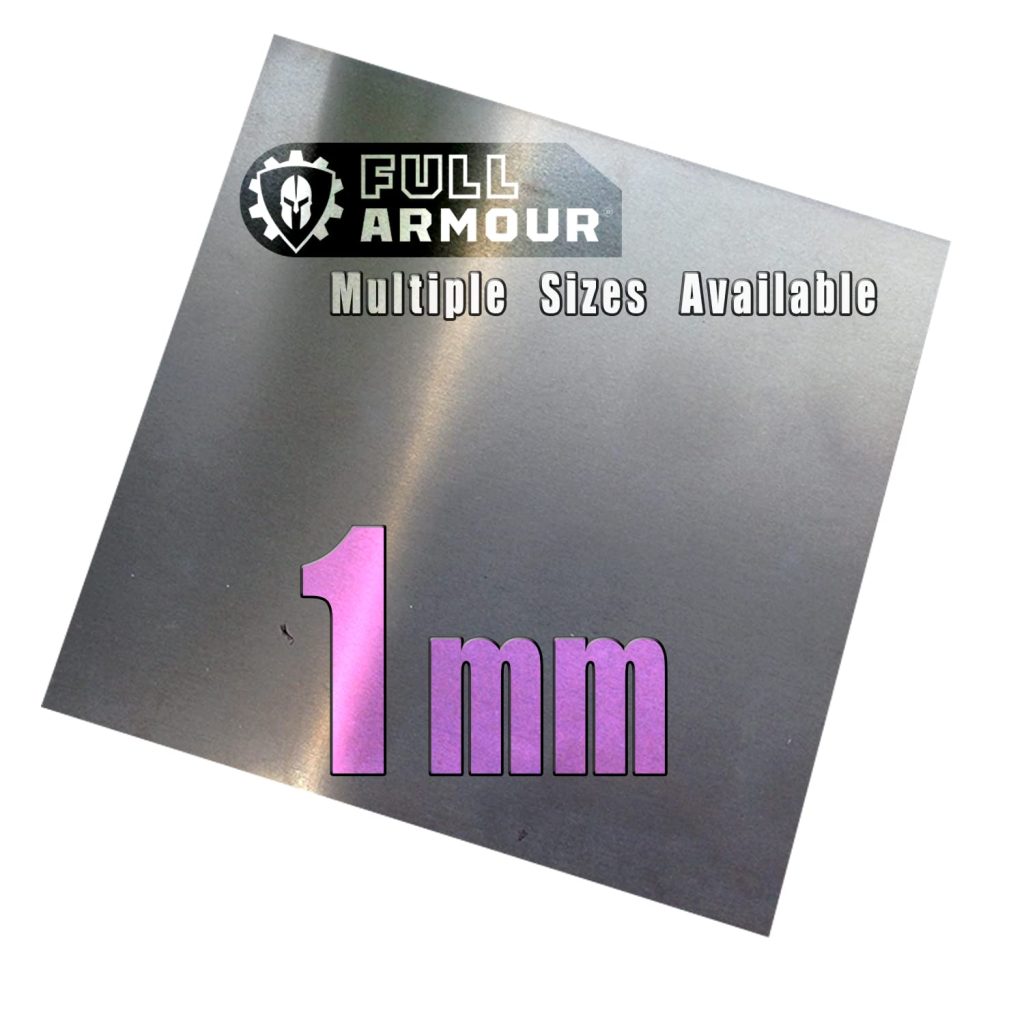
Complete your craft with our high-grade 1mm aluminium, specifically chosen for hobbyists and professionals.
- Easy to Work: Naturally rust-resistant and perfect for engraving, sublimating, or custom metal stamping.
- Precision Sizes: Available in 4″x4″, 7″x5″, and 8″x8″ cuts to minimise waste.
- No minimum order: Whether you need a single sheet for a DIY project or bulk for business, we’ve got you covered.
Order today for a lightweight, durable solution perfect for jewellery, signage, and bespoke fabrication!
Important Disclaimer
The technical advice and cutting settings provided are for informational purposes only. Cricut®, xTool®, Siser® and Silhouette® are trademarks of their respective owners. Full Armour is not affiliated with, endorsed by, or sponsored by these brands. Every machine is calibrated differently; therefore, you follow these suggestions at your own risk. Full Armour is not held accountable for failed cuts, wasted material, or damage to machinery. Furthermore, we accept no liability for personal injury or property damage resulting from these techniques. Always consult your manufacturer’s manual for specific safety protocols. By using this guide, you acknowledge full responsibility for your own safety and the maintenance of your equipment.